
The short answer: After a Texas storm damages your fence, document all damage with photos before touching anything, make only temporary safety repairs, file your insurance claim promptly, and get a professional assessment within 24 to 48 hours. Most Texas homeowner policies cover wind and hail damage to fences under “other structures” coverage. Typical storm fence repairs run $323 to $693, with an average of $481**. Full fence replacement after severe damage runs **$1,500 to $6,000+ depending on materials and length.
Here’s the thing most people don’t realize: Texas experiences an average of 15,104 confirmed severe weather events from January 2023 through April 2026 — including 456 tornado reports, 5,722 large hail reports, and 4,582 damaging wind reports. Your fence isn’t just likely to get hit — it’s statistically probable.
Let’s be honest — after a storm rolls through Central Texas, most homeowners panic. They run outside, start dragging fallen branches off the fence, and make a dozen decisions in the first hour that end up costing them thousands. The Texas Department of Insurance recommends taking pictures of damage and avoiding moving or repairing anything until an insurance adjuster gives guidance.
This guide walks you through exactly what to do after Texas severe weather damages your fence — from the safety checks you need to make first to filing your insurance claim and getting your fence repaired properly.

Table of Contents
Step 1: Safety First — Before You Touch Anything
Step 2: Document Everything Before Any Cleanup
Step 3: Make Emergency Repairs Only
Step 4: File Your Insurance Claim the Right Way
Step 5: Common Storm Damage Types in Texas
Storm Damage Repair Cost Comparison (2026)
Repair vs. Replacement After Storm Damage
The Regrets Homeowners Mention Most
Key Takeaways / Quick Summary
- Safety first: Check for downed power lines, unstable tree limbs, and sharp debris before approaching your fence
- Document everything before cleanup: Photos and video are critical for your insurance claim — the more thorough the better
- Assess within 24–48 hours: Storm-damaged fences in Central Texas should be assessed within 24 to 48 hours of the storm
- Most Texas policies cover fence damage: Fences are covered under “other structures” coverage (Coverage B), typically at 10% of your home’s insured value
- Keep all receipts: Texas officials urge homeowners to document losses and keep receipts for possible reimbursement
- Common damage types: Leaning posts, blown-out panels, broken gates, and hail-chipped metal coatings
- Average repair cost: $481 for typical fence repair in Texas
- Don’t rush permanent repairs: Wait for insurance adjuster inspection unless there’s an immediate safety risk
Step 1: Safety First — Before You Touch Anything
After a major storm, the area around your fence can be genuinely dangerous. Before you start pulling boards or trying to straighten posts, take a few minutes to make sure the area is safe.
What to check:
- Downed power lines: If you see any power lines near the fence or tangled in tree debris, stay away and call your utility company immediately. Do not approach until the line is confirmed de-energized.
- Unstable trees and hanging branches: After storms, trees can have “widowmakers” — hanging branches that can fall without warning while you’re working.
- Sharp debris: Wear gloves and boots. Storm debris often includes splintered wood, exposed nails, and broken fasteners.
- Fence under tension: If a fence is supporting a leaning tree limb, don’t cut it free without help. The fence could snap back violently.
If you have pets or children, keep them indoors and away from the damaged area until repairs are complete.
If you smell gas or see sparking, evacuate immediately and call 911.
Step 2: Document Everything Before Any Cleanup
Your insurance claim depends on thorough documentation. Before you move a single board, capture the full extent of the damage.
What to photograph:
- Wide shots showing the overall scope of damage across your property
- Close-ups of broken posts, damaged panels, bent rails, and gate hardware
- Every damaged section along the fence line — walk the full perimeter and photograph each section
What to save:
- “Before” photos: Check Google Street View, your phone’s camera roll, or real estate listing photos if you have them.
- Receipts for any emergency repairs: Texas officials are urging homeowners to keep receipts for any storm-related repairs for possible state reimbursement.
- A written list of repairs: Document every damaged component and every conversation with your insurance company.
If you have a large fence line (Texas homes often have extensive fence runs), be systematic — photograph each section separately and note its location.

Step 3: Make Emergency Repairs Only
There’s a critical difference between emergency repairs and permanent repairs. After a storm, you should only make emergency repairs to secure your property and prevent further damage.
When you need same-day emergency repair:
- Pets at risk of escape: If a dog can fit through the damaged section, that’s a same-day priority.
- Security or privacy compromised: Backyard exposure to neighbors, alleys, or streets requires immediate attention.
- Pool fence damage: Creates immediate code compliance risk if a pool is present.
- Two or more posts are down: The fence has lost structural integrity and will worsen with wind.
Temporary repair options:
- Tarps or heavy plastic sheeting: Cover large gaps secured with zip ties for temporary privacy.
- Temporary fencing panels: Available at equipment rental companies for larger breaches.
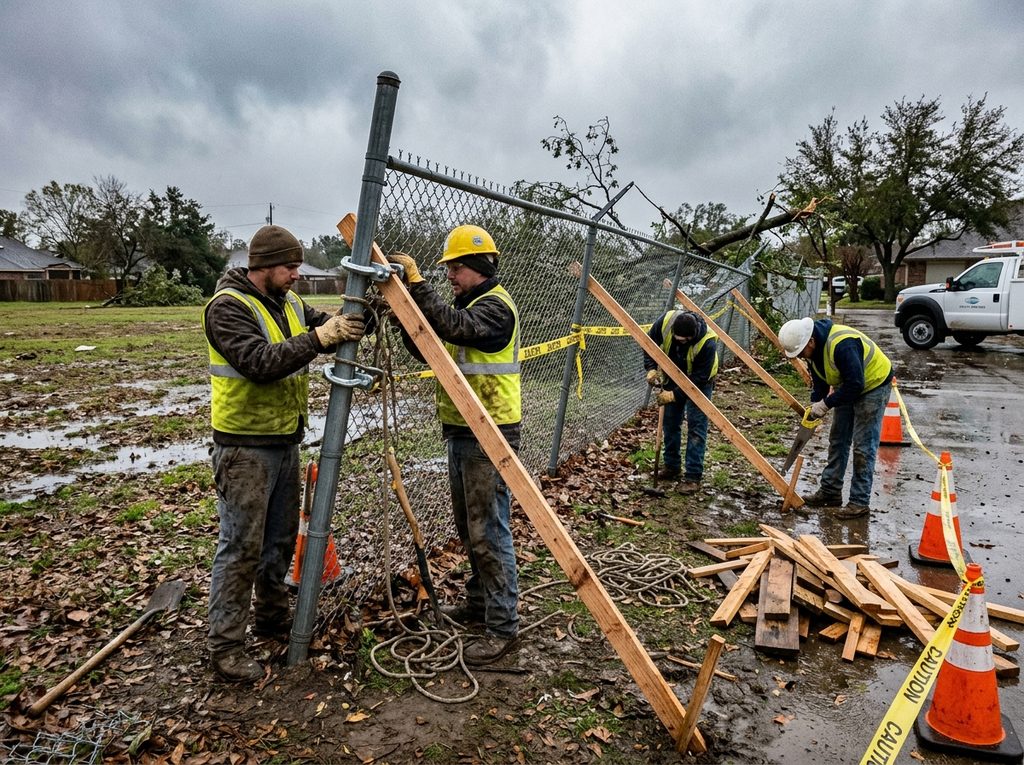
- Brace leaning sections: Prop unstable sections with 2x4s or metal T-posts to prevent further collapse.
If you’re not sure how serious the damage is, start with a professional assessment. Storm-damaged fences in Central Texas should be assessed within 24 to 48 hours of the storm.
If multiple posts are loose, a full section reset is usually more cost-effective than patchwork.
Step 4: File Your Insurance Claim the Right Way
Most Texas homeowners policies cover wind and hail damage to fences. But the claims process requires careful attention to detail.
Understanding your coverage:
Fences are typically covered under “other structures” coverage (Coverage B) at 10% of your home’s insured value. For example, if you have $300,000 of coverage on your house, you have **$30,000** in coverage for other structures.
What’s typically covered:
- Wind damage: Most Texas policies cover fence damage from high winds under “named perils”.
- Hail damage: Hail chips protective coatings on metal fences, opening the metal to moisture and oxidation.
- Falling tree limbs: Covered under most home policies.
What’s typically NOT covered:
- Flood damage: Almost always requires a separate flood insurance policy.
- Ice or snow damage: Most policies don’t pay for fence damage caused by ice or snow unless your house collapses on the fence.
- Age-related deterioration: A fence that collapses due to long-term rot or termite damage may not qualify.
The claims process:
- Review your policy — confirm coverage, deductible, and the claim reporting window.
- Submit your documentation — all photos, videos, and a written list of damaged components.
- Get contractor estimates — your insurance company will require at least one itemized estimate from a licensed contractor.
- File promptly — don’t delay. Keep a log of every communication with your insurer including names, dates, and what was discussed.
Important timeline: In Texas, most standard homeowner policies give you two years from the date of loss to file a storm claim.
If your claim is denied or underpaid: You have the right to dispute a settlement offer. A public adjuster can represent you if the company’s offer doesn’t cover your actual repair costs.

Step 5: Common Storm Damage Types in Texas
Understanding what type of damage you’re dealing with helps you make better repair decisions.
| Damage Type | What It Looks Like | Repair Approach |
| Leaning/Fallen Posts | Posts tilted or pulled from ground | Post resetting or replacement |
| Broken/Missing Panels | Blown-out boards or pickets | Board/panel replacement |
| Warped/Water-Damaged Wood | Boards bowed or soft spots | Board replacement, possibly full section |
| Hail Damage to Metal | Chipped coating, rust spots | Coating repair or panel replacement |
| Damaged Gates | Misaligned hinges, broken latches | Gate hardware repair or replacement |
| Widespread Structural Failure | Multiple posts and panels down | Full fence replacement |
If the damage is isolated to a few boards or one section, repair is usually the smart move.
If the fence is older and more than about a third of a run is compromised, replacement starts to make more sense because you’ll chase weak spots for months.
If you’re dealing with leaning posts specifically, our guide on how to fix a leaning fence walks you through the repair process step by step.
Storm Damage Repair Cost Comparison (2026)
| Repair Type | Average Cost Range | When Needed |
| Board/Picket Replacement | $150 – $400 | Isolated board damage |
| Post Resetting | $150 – $400 per post | Leaning posts |
| Panel Replacement | $200 – $600 | Blown-out sections |
| Gate Repair/Replacement | $100 – $400 | Damaged gates |
| Metal Coating Repair | $100 – $300 | Hail damage to metal |
| Full Section Replacement | $800 – $2,500 | Multiple components damaged |
| Full Fence Replacement | $1,500 – $6,000+ | Widespread damage |
Sources: PermitDeck, HomeAdvisor, Fence Company Austin (2026)
Texas Fence Repair Cost Data
| Market | Average Cost Range | Source |
| Texas Statewide | $323 – $693 (avg. $481) | PermitDeck 2026 |
| Austin | $390 – $560 | HomeYou 2026 |
| Stephenville | $398 – $572 | HomeYou 2026 |
| Bryan | $411 – $591 | HomeYou 2026 |
Fence repair in Texas is approximately 5% below the national average of $509.
Repair vs. Replacement After Storm Damage
| Condition | Recommendation | Why |
| Isolated board damage | ✅ Repair | Cost-effective, quick fix |
| One or two leaning posts | ✅ Repair | Post resetting is straightforward |
| Damage limited to one section | ✅ Repair | Section replacement is straightforward |
| Multiple posts failing across fence | ❌ Replace | Systemic failure — repairs will cascade |
| More than 30% of fence compromised | ❌ Replace | Patching will chase weak spots for months |
| Fence is 15+ years old with widespread issues | ❌ Replace | End of useful life |
Sources: Ark Fence Company, TX Fence & Deck, AT4 Fence (2026)
The 50% Rule: When repair cost exceeds roughly 50 to 60 percent of replacement cost, replacement typically delivers better long-term value.
For a deeper dive into this decision, see our guide on fence repair vs replacement.
Statistical Anchors
According to Peril IQ’s Texas storm history database, Texas has experienced 15,104 confirmed severe weather events from January 2023 through April 2026, including 456 tornado reports, 5,722 large hail reports, and 4,582 damaging wind reports.
According to the Texas Department of Insurance, most home policies cover damage from wind or falling tree limbs, and they’ll also cover damage to fences. Policies usually pay actual cash value for fences, meaning your company will deduct depreciation based on your home’s age and condition.
According to PermitDeck’s 2026 cost analysis, fence repair in Texas typically costs between $323 and $693, with an average of $481 for a typical project.
According to Round Rock Fence Company, storm-damaged fences in Central Texas should be assessed within 24 to 48 hours of the storm. Most non-emergency repairs run within 1 to 2 weeks of assessment.
The Regrets Homeowners Mention Most
Mistake 1: Cleaning up before documenting.
“I started dragging branches off the fence and throwing away broken boards.” But those photos would have been your insurance evidence. The Texas Department of Insurance recommends taking pictures of damage and avoiding moving or repairing anything until an insurance adjuster gives guidance. The regret? A denied or underpaid claim because you couldn’t prove the extent of damage.
Mistake 2: Skipping the safety check.
“I just wanted to get the fence fixed.” But downed power lines and unstable tree limbs have killed homeowners during storm cleanup. Always check for hazards before approaching your fence.
Mistake 3: Making permanent repairs before the adjuster inspects.
“I hired a contractor right away.” But repairing before adjustment can complicate the claim. Wait for insurance authorization unless safety issues require faster action.
Mistake 4: Not keeping receipts.
“I paid the emergency repair guy in cash.” Texas officials are urging homeowners to keep receipts for any repairs for possible state reimbursement. The regret? Money you can’t get back.
Mistake 5: Hiring an unlicensed contractor for repairs.
“I found a guy who could start tomorrow.” But unlicensed contractors often cut corners — shallow posts, no permits, no insurance. When the fence fails again next storm, you have no recourse. Field multiple bids before hiring a contractor and check that any company is licensed and insured.
Mistake 6: Assuming a healthy tree means you can’t hold your neighbor liable.
A fallen tree from a neighbor’s yard damaged my fence.” If the tree was healthy before the storm, you cannot hold your neighbor liable — it’s considered an act of God. Your own insurance is the path to recovery.
Your Storm Damage Fence Repair Checklist
Before You Touch Anything
- □ Check for downed power lines — call utility company if spotted
- □ Watch for unstable tree limbs and hanging branches
- □ Wear gloves and boots — storm debris is sharp
- □ Keep pets and children away from damaged area
Documentation Phase
- □ Photograph all damage — wide shots and close-ups
- □ Walk the full fence line and document each section
- □ Save any “before” photos from your phone or Google Street View
- □ Write a list of all damaged components
- □ Keep receipts for any emergency repairs
Emergency Repairs Only
- □ Secure gaps with tarps or temporary fencing panels
- □ Brace leaning sections with 2x4s or T-posts
- □ Address pet escape and security risks first
- □ Do NOT make permanent repairs before adjuster inspection
Insurance Claim Process
- □ Review your policy — confirm “other structures” coverage
- □ Check your deductible (including separate wind/hail deductibles)
- □ File your claim promptly
- □ Get a contractor estimate to submit with your claim
- □ Keep a log of all communications with your insurer
Professional Assessment
- □ Get a professional fence assessment within 24–48 hours
- □ Ask about repair vs. replacement recommendation
- □ Get itemized written estimates from multiple contractors
- □ Verify contractor insurance and licensing

Common Questions We Get Asked
Does homeowners insurance cover storm damage to fences in Texas?
Yes. Fences are covered under “other structures” coverage (Coverage B) at typically 10% of your home’s insured value. Wind and hail damage are covered perils in most Texas policies.
How much does storm damage fence repair cost in Texas?
Fence repair in Texas typically costs between $323 and $693, with an average of $481. Costs depend on the extent of damage — replacing a few boards is less expensive than resetting multiple posts.
How long do I have to file a storm damage claim in Texas?
Most standard Texas homeowner policies give you two years from the date of loss to file a storm claim.
Should I repair or replace my fence after a storm?
Repair if damage is isolated to a few boards or one section. Replace if multiple posts are failing, more than 30% of the fence is compromised, or the fence is 15+ years old with widespread issues.
What’s the first thing I should do after my fence is damaged?
Document everything before touching anything. Take photos and video of all damage, walk the full fence line, and save any “before” photos. Then make only emergency safety repairs.
Will my insurance company cover temporary repairs?
Most policies cover “reasonable emergency repairs” to prevent further damage. Keep all receipts and document the repairs thoroughly.
How soon should I get a professional assessment?
Storm-damaged fences in Central Texas should be assessed within 24 to 48 hours of the storm. Most non-emergency repairs run within 1 to 2 weeks of assessment.
What if my insurance claim is denied?
You have the right to dispute a settlement offer. A public adjuster can represent you if the company’s offer doesn’t cover your actual repair costs.
Can I hold my neighbor liable if their tree fell on my fence?
Only if the tree was diseased or dead before the storm. If the tree was healthy, you cannot hold your neighbor liable — it’s considered an act of God.
Does insurance cover flood damage to fences?
No. Flood damage almost always requires a separate flood insurance policy. Standard homeowners policies do not cover flood damage.
Ready to Repair Your Storm-Damaged Fence?
A storm-damaged fence is more than an eyesore — it’s a safety, security, and liability issue. Whether you’re dealing with a few broken boards or a collapsed section, getting it fixed properly protects your property and your peace of mind.
Here’s the bottom line: document before you clean up, make only emergency repairs, file your claim promptly, and get a professional assessment within 24 to 48 hours. The first 72 hours after a storm shape your entire claim.
What you should do next:
- Safety first — check for downed lines and unstable trees
- Document everything — photos, video, written list
- Make emergency repairs only — secure gaps and prevent further damage
- File your insurance claim — don’t delay
- Get a professional assessment within 24–48 hours
👉 Schedule a professional fence repair assessment with reliable fencing professionals who understand Texas storm damage and work directly with insurance adjusters. We provide insurance-ready documentation packages and itemized estimates to support your claim.
For more details on pricing, see our guide on fence repair costs. And if replacement is the right choice, explore our affordable wood fence installation options. For a deeper dive into the repair vs. replacement decision, check out fence repair vs replacement.
If you’re looking at a full rebuild, our professional fence construction services can help you build a fence that stands up to the next Texas storm.