
The short answer: Soil type determines how well your fence posts stay put. Clay soil holds posts firmly but expands and contracts with moisture, potentially pushing posts out of alignment. Sandy soil drains quickly but provides less grip, allowing posts to shift more easily. Rocky soil makes digging difficult and can prevent proper concrete setting. The wrong approach for your soil can turn a 20-year fence into a 7-year failure.
Here’s the thing most people don’t realize: what’s happening underground matters more than what you can see above it. The soil surrounding your fence posts plays a crucial role in maintaining stability. And different soil types present unique challenges that require different solutions.
Let’s be honest—most homeowners pick a fence based on how it looks, not on what’s beneath their feet. They choose the materials, the style, the color—and then dig holes like every yard is the same. But soil isn’t uniform. A post that’s rock-solid in loamy soil can be wobbling in sandy ground within months.
This guide explains how different soil types affect fence construction, what you need to know about each one, and how to build a fence that stays standing for decades—no matter what’s under your lawn.

Table of Contents
The Science of Soil: What’s Happening Underground
Soil Type 1: Clay Soil—The Expansive Challenge
Soil Type 2: Sandy Soil—The Shifting Problem
Soil Type 3: Rocky Soil—The Digging Nightmare
Soil Type 4: Loam and Mixed Soil—The Goldilocks Zone
Soil Bearing Capacity: The Numbers That Matter
Soil-Specific Installation Adjustments
Soil Type Impact on Fence Lifespan
The Regrets Homeowners Mention Most
Key Takeaways / Quick Summary
- Soil bearing capacity varies dramatically—from 1,000 psf for soft clay to 6,000 psf for dense sand or gravel
- Clay soil holds posts firmly but expands and contracts with moisture, potentially pushing posts out of alignment
- Sandy soil drains well but provides less grip, allowing posts to shift more easily
- Rocky soil prevents proper post hole digging and concrete setting, creating uneven support
- Frost heave occurs when moisture in the soil freezes and expands, creating upward pressure that can disrupt fence post stability
- Posts must extend below the frost line to prevent heaving
- In frost zones, footing depths of 36 to 48 inches are common in northern jurisdictions
The Science of Soil: What’s Happening Underground
A fence post functions as a vertical cantilever beam fixed at its base. When wind pressure acts on the fence panel, that load transfers to the post as a lateral force. The post resists this force through passive soil pressure acting on the embedded portion of the post. In other words, the soil itself is holding your fence upright.
The depth of embedment is the primary mechanical variable. A post embedded to one-third of its total length is the conventional field rule—a 6-foot fence post requires at least 2 feet of embedment, producing a total post length of 8 feet.
But here’s the catch: that rule assumes “average” soil conditions. When you’re dealing with clay, sand, or rock, the rule changes.
Soil Type 1: Clay Soil—The Expansive Challenge
What it is: Heavy, dense soil that retains water and expands when wet, contracts when dry.
Why it’s tricky: Clay soil tends to hold posts more firmly but expands and contracts with moisture. This constant movement can wreak havoc on fence posts. In areas with high clay content—like North Georgia, where clay content often exceeds 35%—posts installed without proper preparation rarely last beyond 7–10 years.
The solution:
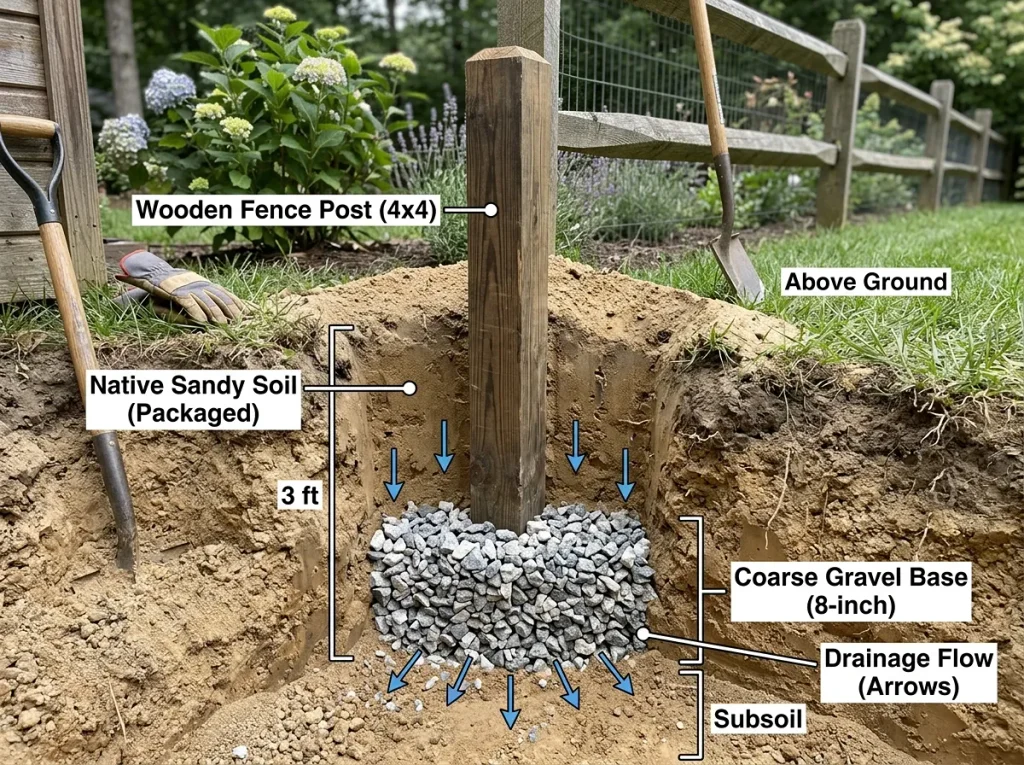
- Add gravel at the base of the hole for drainage
- Use a wider diameter hole to accommodate expansion
- Avoid trapping water against the post—in clay soil, concrete can trap water against wood, accelerating rot
- Some professionals recommend digging the hole deeper than the post, adding gravel to the bottom, and tamping loose gravel or crushed rock around the post instead of using concrete
If you’re in an area with expansive clay soils (classified as CH or MH under the Unified Soil Classification System), you may need a geotechnical assessment to determine bearing capacity before footing dimensions can be applied.

Soil Type 2: Sandy Soil—The Shifting Problem
What it is: Loose, granular soil that drains quickly but provides less compression and support.
Why it’s tricky: Sandy soil drains well but does not provide the same grip as clay. Posts may sink or shift more easily. In loose, sandy soil, the post has less passive soil pressure to resist lateral loads.
The solution:
- Use wider diameter holes to create more surface area for the concrete footing
- Deeper installation is necessary to prevent movement
- Use concrete footings rather than gravel—concrete locks the post in place and helps resist shifting caused by soil movement or heavy loads
- In some cases, you may need to widen the post hole to improve support with concrete
If your soil is sandy or loose fill, you’ll need to plan for deeper posts and more robust footings.
Soil Type 3: Rocky Soil—The Digging Nightmare
What it is: Hard, uneven ground with rock, caliche, or limestone deposits.
Why it’s tricky: Rocky soil prevents proper post hole digging and concrete setting, creating uneven support. Standard augers won’t cut it—you may need pneumatic tools, core drilling, or specialized anchors.
The solution:
- Use specialized equipment—carbide-tipped augers, pneumatic jackhammers, or core drills
- Consider chemical grouting instead of traditional digging
- Once the post is seated, rocky soil provides high bearing capacity—the rock itself becomes the foundation
If you’re in an area with caliche or limestone, expect your installation to take longer and cost more. But the upside: once those posts are in, they’re not going anywhere.

Soil Type 4: Loam and Mixed Soil—The Goldilocks Zone
What it is: A balanced mixture of sand, silt, and clay with moderate drainage and cohesion.
Why it’s ideal: Loam is the most reliable soil for fence posts. It provides good support, adequate drainage, and doesn’t expand or contract excessively. Most residential fences perform best when installed in loamy soil.
The solution: Standard installation methods work well here. Follow the one-third rule (2 feet deep for a 6-foot fence), use concrete footings, and you’re good to go.
The Frost Heave Factor
Frost heave occurs when moisture in the soil freezes and expands, creating upward pressure that can disrupt the stability of fence posts. When the ice melts, the post may not settle back into its original position. Over multiple freeze-thaw cycles, this can push posts completely out of the ground or cause them to snap under pressure.
The solution:
- Posts must extend below the frost line to prevent heaving
- Frost line depths vary dramatically by region—6–12 inches in southern states like Texas and Florida, 24–36 inches in the mid-Atlantic and Midwest, and 48–72 inches in northern states
- Footings must extend below the local frost line—a footing that terminates above the frost line will move seasonally, cracking or displacing the fence
- Add gravel at the base to improve drainage—dry soil is far less likely to move during winter
If you live in a region with freeze-thaw cycles, this is non-negotiable. Posts set too shallow without proper drainage are especially vulnerable.

Soil Bearing Capacity: The Numbers That Matter
Soil bearing capacity is the ability of soil to support the load transferred to it from a foundation. Under the International Building Code (IBC) Table 1806.2, different soil types have different presumptive load-bearing values.
| Soil Type | Allowable Bearing Capacity (psf) | What It Means for Your Fence |
| Soft Clay | 1,000 | Very poor support—requires deep, wide footings |
| Firm Clay | 75 kN/m² (~1,566 psf) | Moderate support—expand depth and add drainage |
| Stiff Clay | 150 kN/m² (~3,133 psf) | Good support—standard methods work with drainage |
| Sand / Silty Sand / Clayey Sand | 2,000 | Moderate support—deeper posts, wider holes needed |
| Sandy Gravel / Clayey Gravel | 3,000 | Good support—standard methods work |
| Dense Sand or Gravel | 4,000 – 6,000 | Excellent support—standard methods work |
| Sound Rock | 500 kN/m² (~10,443 psf) | Excellent support—once seated, posts are extremely stable |
Sources: NBCC, IBC Table 1806.2, National Fence Authority (2026)
The IBC and IRC reference soil bearing capacity and frost depth calculations—neither document specifies a universal one-third ratio as the compliant standard. The depth required depends on your specific soil conditions.
Soil-Specific Installation Adjustments
| Soil Type | Recommended Adjustments | Why |
| Clay Soil | Add gravel at the base; use wider diameter holes; consider gravel backfill instead of concrete | Prevents water retention and expansion damage |
| Sandy Soil | Use wider diameter & deeper holes; use concrete footings | Prevents sinking and shifting |
| Rocky Soil | Drill holes or use chemical grouting instead of digging | Overcomes excavation challenges |
| Black Soil | Expand depth to avoid post movement in wet seasons | Prevents seasonal shifting |
| Frost-Prone Areas | Extend below frost line (36–48+ inches in northern zones) | Prevents frost heave |
Soil Type Impact on Fence Lifespan
| Soil Type | Typical Post Lifespan | Primary Failure Mode |
| Loam / Mixed Soil | 20–25+ years | Normal aging, occasional rot |
| Clay (with proper drainage) | 15–20 years | Frost heave, expansion/contraction |
| Clay (without drainage) | 7–10 years | Rot, shifting, premature failure |
| Sandy Soil (with concrete) | 15–20 years | Shifting, sinking |
| Sandy Soil (without concrete) | 5–10 years | Lateral movement, leaning |
| Rocky Soil | 25–40+ years | Difficult installation, but once set—extremely stable |
Statistical Anchors
According to the National Fence Authority, improper footing depth or diameter is among the most cited causes of fence failure in post-storm inspections.
According to soil engineering standards referenced through ASTM D2487, soil bearing capacity categories range from soft clay (1,000 psf allowable bearing pressure) to dense sand or gravel (4,000–6,000 psf).
According to the International Building Code (IBC) and International Residential Code (IRC), expansive clay soils, fill material, and poorly drained sites may require geotechnical assessment under IBC Section 1803 to determine bearing capacity before prescriptive footing dimensions can be applied.
According to frost depth data published by the National Weather Service, frost lines range from 0 inches in southern Florida to over 60 inches in northern Minnesota.
The Regrets Homeowners Mention Most
Mistake 1: Using the same depth for all soil types.
“I figured two feet was two feet.” But in sandy soil, two feet isn’t enough. In clay, two feet without drainage is a recipe for rot. The regret? A fence that starts leaning within 2–3 years.
Mistake 2: Not adding gravel in clay soil.
“I just poured concrete straight into the hole.” And now water pools at the base of your posts, accelerating rot. The regret? Replacing posts that should have lasted 20 years after just 7–10.
Mistake 3: Ignoring the frost line.
“I didn’t think about frost heave.” But freeze-thaw cycles can push posts completely out of the ground. The regret? A fence that’s completely out of alignment after one hard winter.
Mistake 4: Using gravel in sandy soil.
“Gravel works in clay, so it should work everywhere.” But gravel doesn’t provide the same structural support as concrete in sandy soil. The regret? Posts that shift every time it rains.
Mistake 5: Not calling 811 before digging in rocky soil.
“I didn’t think I’d hit anything.” But rocky soil often means utility lines are harder to locate. The regret? Hitting a gas line because you didn’t wait for utility marking.
Best Practices by Soil Type
For Clay Soil
- Add 4–6 inches of gravel at the bottom of each hole for drainage
- Dig deeper and wider than standard recommendations
- Consider gravel backfill instead of concrete to allow water to drain away from the post
- Slope the top of the concrete away from the post so water doesn’t pool against it
For Sandy Soil
- Use wider diameter holes (10–12 inches minimum)
- Set posts deeper—add 6–12 inches beyond the one-third rule
- Use concrete footings for long-term stability
- Consider larger diameter posts to increase surface area
For Rocky Soil
- Use specialized equipment—carbide-tipped augers or pneumatic jackhammers
- Consider chemical grouting instead of traditional digging
- Expect longer installation time and higher costs
- Once set, enjoy exceptional stability—rock provides excellent bearing capacity
For Frost-Prone Areas
- Extend footings below the local frost line
- Add gravel at the base for drainage
- Use bell-shaped bottoms for additional stability
- Consider sand and coarse gravel added to the soil as insulation against frost heave
How to Identify Your Soil Type
Simple field tests:
- The squeeze test: Take a handful of damp soil and squeeze it. If it holds together firmly and feels sticky, it’s clay. If it crumbles immediately, it’s sandy. If it holds together but crumbles when poked, it’s loam.
- The ribbon test: Roll damp soil between your palms. Clay forms a long, smooth ribbon. Sandy soil won’t form a ribbon at all. Loam forms a short, crumbly ribbon.
- The jar test: Fill a jar with soil and water, shake it, and let it settle. Sand settles first (within minutes), silt settles next (within hours), and clay stays suspended (days). The layers show your soil composition.
Professional assessment:
- Residential contractors rely on probe resistance and visual cues: red clay signals high cohesion; fine, running sand signals low lateral resistance
- On commercial projects, a geotechnical report may define bearing capacity in pounds per square foot (PSF)
- The USDA Web Soil Survey provides mapped soil data by county and is used in preliminary site assessments
Common Questions We Get Asked
Why does soil type matter for fence posts?
Soil type determines how well your fence posts stay put. Different soils have different bearing capacities, drainage properties, and expansion/contraction characteristics. The wrong approach for your soil can cause posts to lean, shift, or fail prematurely.
How deep should fence posts be in clay soil?
Clay soil requires deeper holes with gravel at the base for drainage. A 6-foot fence in clay should have posts set at least 2.5 feet deep with 4–6 inches of gravel at the bottom. In areas with high clay content, posts installed without proper drainage rarely last beyond 7–10 years.
How deep should fence posts be in sandy soil?
Sandy soil requires deeper and wider holes with concrete footings. A 6-foot fence in sandy soil may need posts set 2.5–3 feet deep with 10–12 inch diameter holes.
What is the best soil for fence installation?
Loam soil is the most reliable soil for fence posts. It provides good support, adequate drainage, and doesn’t expand or contract excessively.
Should I use concrete or gravel for fence posts?
It depends on your soil. Concrete is best for sandy soil and most standard installations—it locks the post in place and resists shifting. Gravel can work well in clay soil, allowing water to drain away from the post. In clay soil, concrete can trap water against the wood, accelerating rot.
What is frost heave and why does it matter?
Frost heave occurs when moisture in the soil freezes and expands, creating upward pressure that can push fence posts out of the ground. Over multiple freeze-thaw cycles, this can cause complete fence failure. Posts must extend below the local frost line to prevent this.
How deep do fence posts need to be to prevent frost heave?
Posts must extend at least 6 inches below the local frost line. Frost line depths vary dramatically: 6–12 inches in southern states, 24–36 inches in the mid-Atlantic and Midwest, and 48–72 inches in northern states.
What happens if I don’t account for soil type?
You risk premature fence failure. Posts may lean, shift, or collapse within 5–10 years instead of lasting 20–30. Improper footing depth or diameter is among the most cited causes of fence failure in post-storm inspections.
Can I install a fence myself in rocky soil?
Yes, but it’s significantly more difficult. You’ll need specialized equipment—carbide-tipped augers, pneumatic jackhammers, or core drills. In some cases, chemical grouting may be necessary instead of traditional digging. Consider hiring a professional for rocky terrain.
How do I know what type of soil I have?
Try the squeeze test: take a handful of damp soil and squeeze it. Clay holds together firmly and feels sticky. Sandy soil crumbles immediately. Loam holds together but crumbles when poked. For a more precise assessment, consult the USDA Web Soil Survey or hire a geotechnical professional.
Ready to Build a Fence That Matches Your Soil?
Your fence is only as strong as the ground it’s planted in. Understanding your soil type isn’t just technical detail—it’s the difference between a fence that lasts 20 years and one that fails in 7.
Here’s the bottom line: common construction mistakes to avoid start with understanding what’s underground. Take the time to identify your soil type, adjust your installation methods accordingly, and build a fence that stays standing for decades.
What you should do next:
- Identify your soil type—try the squeeze test or consult the USDA Web Soil Survey
- Check your local frost line—this determines minimum post depth
- Adjust your installation plan based on your soil—deeper for sand, gravel for clay, specialized equipment for rock
- Call 811 at least three business days before digging
- Get quotes from contractors who understand soil-specific installation
👉 Explore our professional fence construction services and see why we’re the choice of expert fence builders in Austin. See our detailed fence construction process and work with Austin’s most trusted fencing company we know Central Texas soil and build fences that last.
For a complete guide on getting your property ready, check out preparing your yard for construction day and how to prepare your yard for our team.